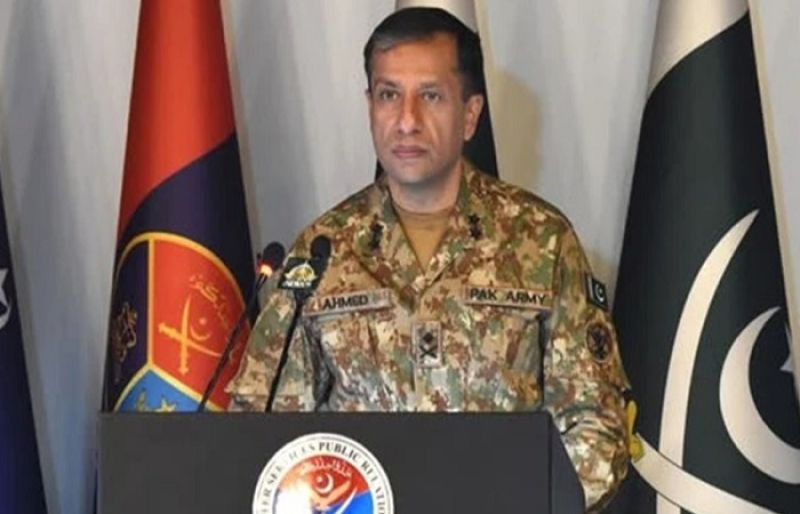
Inter-Services Public Relations (ISPR) Director-General Lt Gen Ahmed Sharif Chaudhry on Thursday exposed another Indian false-flag operation, producing before the media Havildar Muhammad Asif — a retired Pakistani Army soldier whom India had falsely claimed to have killed in a staged encounter in Indian Illegally Occupied Jammu and Kashmir (IIOJK).
Addressing a press conference, the ISPR DG said the incident had begun on the night of September 29 when the Indian Corps posted on social media that a joint search operation had been launched in the general area of Korag, Yousmarg, during which one terrorist had been neutralised.
Nearly seven hours later, the Indian Army issued an update claiming that the body of a Lashkar-e-Taiba terrorist identified as Mohammad Asif alias Hashim Moosa had been recovered along with war-like stores in the general area of Palmaidan.
Shortly after, Indian news agency ANI published a detailed account claiming Mohammad Asif was born on March 7, 1980, had joined the Pakistan Army in 2000 under service number PA-3106947, retired with the rank of Havildar, was inducted into the Special Services Group in 2005, served with 4 Commando Yalgar Battalion, was posted to Balochistan from 2006 onward, participated in approximately 10 operations against Baloch insurgents, was credited with 13 kills and had served on the VVIP security team of former President Pervez Musharraf between 2006 and 2009.
"You might be recalling Uri, Pahalgam and Pulwama — a very interesting story is being cooked, and the story is now complete," the ISPR DG said, adding that there was a lot of evidence available.
He then produced Havildar Muhammad Asif — alive — before the assembled media, comprehensively demolishing India's fabricated account and exposing another in a series of staged incidents designed to manufacture a Pakistani terrorist narrative in IIOJK.
Chaudhry noted that India had claimed that Muhammad Asif was involved in attacks in different areas. "India had claimed that Asif was a retired Special Services Group (SSG) Havildar," he added.
Speaking alongside the military’s spokesperson during the press conference, Asif said that he is a resident of Tehsil Pindigheb, Attock District.
“Yesterday evening, I received phone calls from friends informing me that Indian media and social media platforms were reporting that the Indian Army had killed me in an encounter in Kashmir. They asked me where I was. I told them that I was alive and well, sitting at home, Alhamdulillah.”
Soon after, he said he started receiving calls from unknown Indian numbers inquiring about his personal details and asking whether he was related to the person mentioned in the news.
“I repeatedly blocked those numbers. Shortly afterwards, I saw news broadcasts showing my photograph and personal military record, claiming that I had been martyred in Kashmir,” the ex-SSG commando further said.
“I was utterly astonished. I was sitting at home, yet they were claiming to have killed me in Kashmir,” he added.
Asif said he immediately informed his former unit leadership to clarify that he was safe and at home, so that no false impressions or accusations could be created. “They advised me to block the calls and informed me that the ISPR would contact me to present the truth.”
He added: “When the ISPR reached out and asked about the situation, I confirmed that I was alive. They requested me to come forward and state the facts publicly.”
To provide his background, Asif said that he enlisted in the Pakistan Army's Artillery Corps in 2000. In 2005, he said that he joined the SSG.
“I served with honour and dedication for 18 years before retiring in 2023. Following my retirement, I worked for three years with a private security firm. For the past few months, I have been fully retired and running my own small business at home.
“The allegations made by India against me and my country — claiming that I was involved in cross-border terrorism — are entirely false, fabricated, and baseless. I strongly condemn these lies propagated by the Indian media.
“Alhamdulillah, I am alive and standing before you today. There is no doubt about my identity. I have my official CNIC and military identity documents with me.”
Asif added that throughout his service in the SSG, he was trained to fight face-to-face with valour, not from behind cover or through deceit.
“I have always been ready to defend my motherland, and I remain ready today. My life belongs to this nation. Thank you!"
Meanwhile, the ISPR DG further said that India sponsors terrorist organisations for carrying out terrorism in Pakistan.
He noted that there were multiple reasons behind Indian "false-flag drama", adding that India was the biggest country spreading terrorism in the world.
He also said that Indian support and funding for the Mukti Bahini and Tehreek-e-Taliban Pakistan (TTP) was well known.
Furthermore, Lt Gen Chaudhry slammed India for attributing its internal problems to Pakistan and creating “fake stories” to support its narrative.
The ISPR DG said India could not "externalise" its internal issues of oppression and torture by blaming Pakistan for incidents in IIOJK.
He said India should provide evidence if it had any proof of Pakistan’s involvement in an incident, adding that Pakistan had previously offered to examine evidence through a third party. “Please get out of this obsession with Pakistan. You have your internal issues, you have your own problems — deal with them,” he said.
The ISPR DG also criticised India for becoming increasingly focused on what he called the “theatre of war”, saying that incidents were presented as encounters with a Pakistani connection regardless of the facts.
He said the emphasis appeared to be on creating a compelling narrative rather than establishing facts, adding that Pakistani elements and references to the SSG were incorporated into such accounts.
He also criticised India’s “theatre of war”, saying incidents including Uri, Pathankot and Rajouri were repeatedly presented through an encounter-based narrative.
“Gradually, you only become — from Hindustan, they have turned it into ‘Encounter-stan’,” he said, adding that a professional military should not make claims that did not exist.
He also slammed India for creating and accepting what he called “fake stories”, questioning how a professional military could make claims that, according to him, had no factual basis.
“What has happened to this professional army?” he asked, questioning why senior Indian military commanders would approve and take responsibility for such claims.
The ISPR DG further criticised India’s belief in a “shining India” narrative, saying control over domestic media did not mean other countries could also be persuaded to accept the same accounts.
“The world has seen through that shine,” he said.
He noted that Indian media outlets had previously reported claims about events in Pakistan that did not occur, arguing that such narratives could not simply be imposed on international audiences.
Lt Gen Chaudhry also questioned the politicisation of the Indian military, saying that military institutions were creating narratives to please political leadership.
“It is very unfortunate,” he said, adding that Pakistan did not deal with its neighbour through irresponsible behaviour.
The DG ISPR added that Pakistan, the region and the wider world were dealing with a neighbour that considered “every mistake as a solution” and sought to address issues through force.
Responding to a question, the ISPR DG reiterated that Pakistan remained fully committed to implementing the defence agreement with Saudi Arabia.
He said details of defence cooperation under the Makkah alliance were confidential and could not be discussed in the media.
“Our commitment to the security of the Haramain Sharifain is absolute,” he said, adding that Pakistan was prepared to defend the holy sites and ensure the security of the Kingdom of Saudi Arabia.
He also said that Pakistan would make every effort necessary to protect its national security and geographical borders. “There will be no compromise whatsoever on Pakistan’s security and protection of its geographical borders,” he said.
He added that the armed forces were fully prepared to respond to every action by the enemy. “If they want to do something, let them. We are always prepared,” the DG ISPR said.
DG ISPR declines questions on politics
Responding to questions about the Pakistan Tehreek-e-Insaf (PTI) long march and party founder Imran Khan, the ISPR DG said the military had nothing to do with politics.
He said he would not respond to questions concerning political matters. “Politics is for political parties. Politicians and political parties form governments,” he said.
The DG ISPR reiterated that the armed forces would not comment on political matters.
“The armed forces of Pakistan are subject to the Constitution and abide by the orders of the state,” he said.
He added that Pakistan had been fighting terrorism for the past two decades and was among the countries most affected by terrorism worldwide.
“For us, the most important thing is that if there is a state, there is politics,” Lt Gen Chaudhry said, adding that the fight against terrorism could not be compromised for anyone’s political interests.