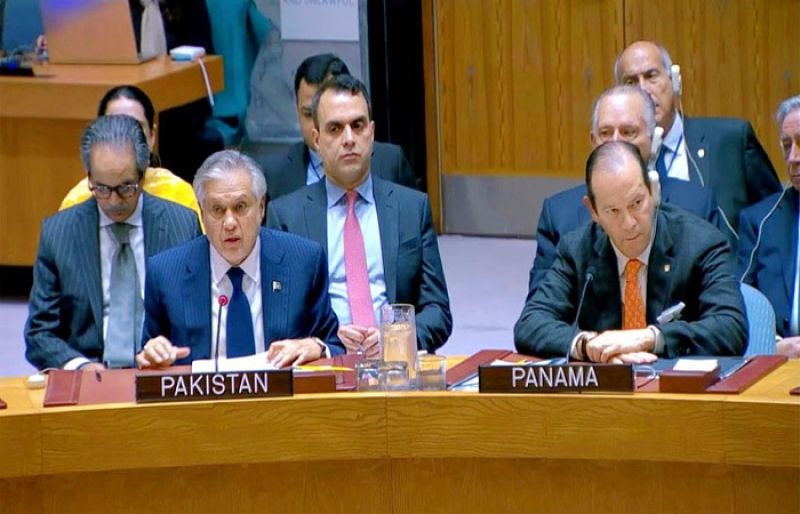
Deputy Prime Minister and Foreign Minister Ishaq Dar says durable peace in South Asia cannot be built on denial, unilateralism or repression.
He expressed these remarks at the UN Security Council Open Debate on "Maintenance of International Peace and Security: Upholding the Purposes and Principles of the UN Charter and Strengthening the UN-centered International System" today.
The Deputy Prime Minister said, for nearly eight decades, the Jammu and Kashmir dispute has remained unresolved despite clear and multiple Security Council resolutions promising the Kashmiri people their right to self-determination.
He said durable peace in South Asia cannot coexist with attempts to place the Indus Waters Treaty in abeyance, which is a vital framework for water cooperation and regional stability.
Ishaq Dar said water must never be weaponized; treaties must be honoured; and disputes must be resolved through adherence to international law, dialogue and justice, and implementation of relevant Security Council resolutions.
Regarding Palestine issue, Ishaq Dar said there can be no durable peace in the Middle East while occupation, collective punishment, forced displacement and illegal expansion of settlements continue. He said the situation in Gaza and the West Bank is becoming increasingly volatile and demands our continuous attention.
He said the momentum generated by the New York Conference on Two-State solution and the Gaza Peace Plan presented by President Donald Trump endorsed by Security Council resolution 2803 must be sustained till its logical conclusion.
He said Pakistan reaffirms its unwavering support for the Palestinian people’s right to self-determination and to an independent, viable and contiguous State of Palestine, based on pre-1967 borders, with Al-Quds Al-Sharif as its capital.
Regarding the Middle East crisis, the Deputy Prime Minister said another prolonged conflict would serve no one. He said the conflict would endanger regional peace, disrupt global energy flows, deepen humanitarian suffering, and strain an already fragile international order.
Ishaq Dar said that, as a friendly neighbour of Iran and of brotherly Gulf countries, and as a country with longstanding ties of amity with the United States, Pakistan has consistently stood for restraint, de-escalation, and a return to diplomacy.
He said Pakistan has made sincere efforts to facilitate a durable solution that ensures lasting peace and stability in the region and keeps maritime routes open for all. Ishaq Dar added that Pakistan is continuing this endeavour with resolve and dedication.
He said the path forward lies in diplomacy and that efforts must succeed in the interest of regional and global peace and security.
The Deputy Prime Minister said Pakistan supports comprehensive reform of the UN Security Council to make it more representative, democratic, transparent, accountable, and effective.
Ishaq Dar said reform must not enlarge privilege or create new permanent seats of power. He added that a reformed council must reflect the collective interests of the wider membership, particularly developing countries. He said an equitable reform based on an increase in the number of elected non-permanent seats allocated to regions, together with improved working methods, is the only feasible way forward.