Gwadar is facing a battle that cannot be measured only in ships, cargo or cranes. Alongside the physical development of Pakistan’s deep sea port, an increasingly intense information battle is taking place online where old videos are recycled, fabricated claims are amplified and isolated incidents are presented as proof that an entire economic project has failed.
The question, therefore, is no longer simply what is happening in Gwadar. The bigger question is: who benefits when Pakistanis are convinced that Gwadar has no future? The answer requires looking beyond social media posts and political rhetoric.
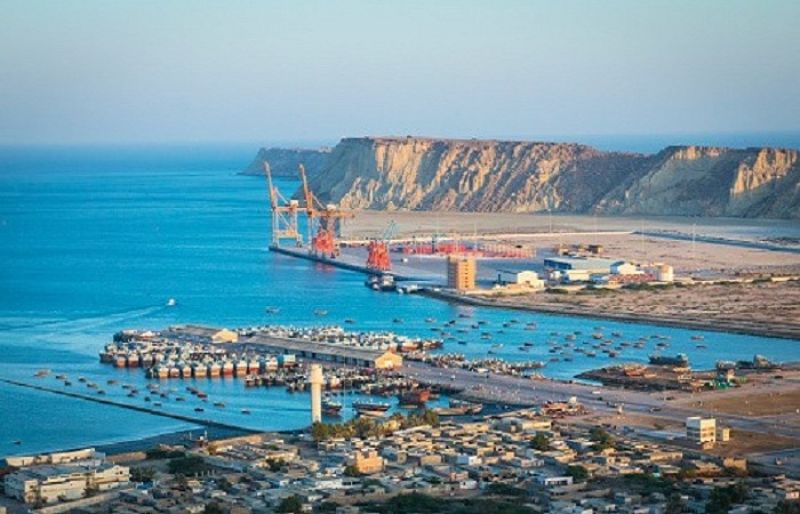
Gwadar occupies a strategically important position on the Arabian Sea and is a central component of CPEC. Its significance is not limited to the revenue generated by ships entering the port. Its larger potential lies in creating a network linking maritime trade with highways, logistics, warehousing, industrial activity and regional transit trade. And there are signs that this process is continuing.
According to the Gwadar Port Authority's current vessel data, ten vessels had been berthed at the port, with 194,304 metric tons of cargo handled, while additional vessels were waiting at anchorage. Cargo handled in 2026 has included steel billets, machinery, fertilizer and general transshipment cargo.
In May, Gwadar handled a vessel carrying more than 53,000 metric tons of steel billets with a draft of around 12.8 metres an operational milestone demonstrating that the port can accommodate large deep draft vessels.
More significantly, recent developments show that the conversation around Gwadar is gradually moving from construction towards commercial activity. In July 2026, the Gwadar Port Authority signed a Letter of Intent with a Chinese company covering investment promotion, supply chain integration, technical cooperation and seafood processing and export-oriented industries.
So why does the narrative of a “failed Gwadar” continue to circulate?
Because information warfare does not necessarily require inventing an entirely fictional story. Sometimes it only requires taking a genuine weakness and presenting it as the whole story.
A security incident becomes “Gwadar is unsafe.” A quiet day at the port becomes “there is no trade.” An old photograph becomes “proof” of a recent attack. A legitimate complaint about local development becomes evidence that the entire CPEC project has collapsed.
Fact checking efforts have repeatedly identified this pattern. In July 2026, a video circulated by the banned BLA claiming to show a successful attack in Jiwani was found to contain digitally manipulated footage. Earlier, false claims of an explosion in Jiwani were also circulated on social media.
This is where the role of hostile militant and external information networks becomes important.
The Balochistan Liberation Army has openly targeted Chinese interests, CPEC infrastructure and Gwadar. Reuters has reported that the banned separatist organization has carried out attacks against Pakistani security forces, Chinese nationals and infrastructure associated with CPEC, including Gwadar.
The objective of such attacks extends beyond physical damage. Terrorism can produce an economic effect even when the physical damage is limited. If international investors, shipping companies and businesses begin to believe that an area is permanently unsafe, investment decisions can be affected.
This is where violence and disinformation can reinforce each other.
An attack creates fear. Social media amplifies the fear. Misleading footage magnifies the apparent scale of the attack. Anonymous accounts repeat the narrative. Eventually, the original incident becomes almost irrelevant; what matters is the perception created around it.
There is another important dimension the information battlefield itself.
Old footage has repeatedly been presented as new. In March 2025, Dawn's iVerify found that several videos circulated in connection with the Jaffar Express attack were either unrelated or years old. One video carrying a BLA logo had originally appeared online in 2022.
So the challenge for Pakistan is not merely countering terrorism. It is countering the narrative infrastructure that can turn terrorism into an economic weapon.
The information campaign has also increasingly moved into the cyber domain, where social media platforms can be used to manufacture a perception of instability around Gwadar at a speed traditional propaganda could never achieve. Fake accounts, coordinated posts, manipulated videos, recycled photographs and misleading captions can make an old or unrelated incident appear to be a fresh development in Gwadar. Hashtags and identical narratives repeated across multiple accounts can create the impression of widespread public sentiment even when the original information comes from a very limited number of sources. The objective of such cyber propaganda is not necessarily to convince everyone that every claim is true; creating doubt, fear and uncertainty can be enough to damage investor confidence and Pakistan's international image. This makes digital literacy, rapid fact checking and transparent communication particularly important in protecting Gwadar from an information war that increasingly operates beyond its physical boundaries..
The port continues to handle cargo. New transshipment activity is emerging. Foreign delegations are exploring investment opportunities. Pakistan is seeking greater regional transit trade, while cooperation is expanding in areas such as logistics, fisheries and industrial investment.
Gwadar should consequently be judged by where it is going not merely by where it stands today.
For Pakistan, the stakes are considerable. A successful Gwadar can strengthen maritime trade, diversify the country's port infrastructure, create logistics and industrial opportunities, connect regional markets and give Balochistan a larger role in Pakistan's economic future.
That is why Gwadar has become more than a port.
It has become a contest over Pakistan's economic direction and increasingly, a contest over the information people believe about it.
The answer to hostile narratives should not be another narrative.
It should be facts, transparency, security, local development and measurable economic progress.
Because if Gwadar succeeds, it will not simply be a successful port. It will represent Pakistan's ability to turn its geography into economic power.
And that is precisely why the battle over Gwadar is being fought not only at the port but also on the screens of millions of people.